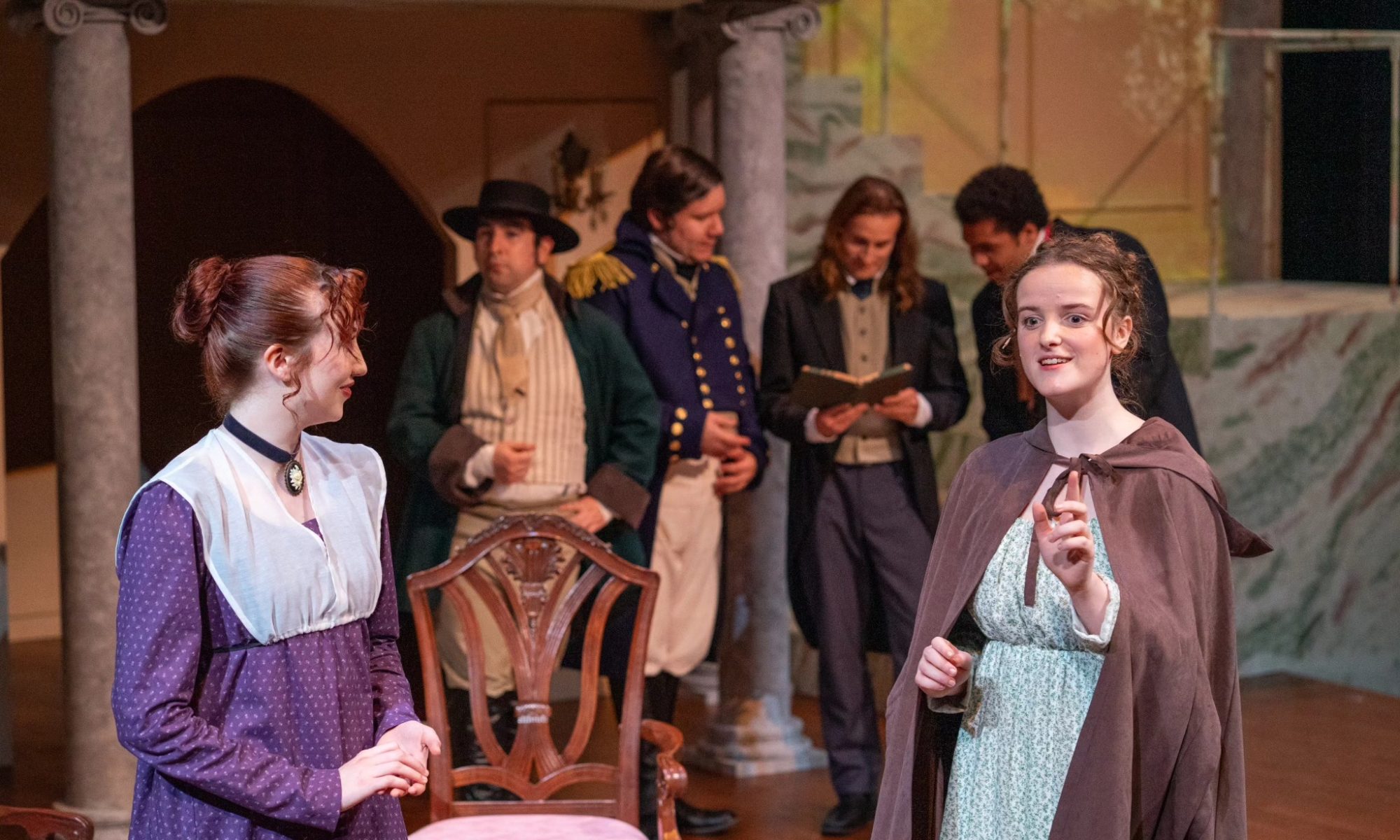
In reflecting on my early directing projects, I am struck by how clearly they predict a Francophile sensibility and an emphasis on genre and style. When I was in high school, I directed Edmond Rostand’s neo-Romantic comedy The Romancers. At my community theatre, I directed a one-act adaptation of a seventeenth-century farce called The French Cabinetmaker. For the final project in my undergraduate directing class I chose Tristan Tzara’s Dada play The Gas Heart.My appreciation for style and genre continues to guide me as a director, helping to provide an emotional orientation toward a production. For example, sharing my interpretation of The Misanthrope as a “Bitter Comedy” afforded designers and actors a better understanding of my approach to the play.
Shifting vocabularies in several university theatre departments and professional theatre settings have helped to shape my directing process. What remains consistent is that the director is responsible for storytelling. In my current department, the preferred vocabulary for this is a Premise statement taking the form “X leads to Y.” For my recent production of The Importance of Being Earnest, the Premise was “Self-discovery and self-revelation lead to connection with others.” I like to start design discussions by pulling some images together in a PowerPoint to share with the production team. I often start with historical images, but also include other kinds of images I might find inspiring for their evocation of a particular feeling, aesthetic, or color palette.
In working with actors I anticipate that they will make choices about the role, and that I will function as an editor to help them shape those choices in rehearsal. Because I often work with less-experienced actors, I am also prepared to offer options for the kinds of choices they might make. I prefer to frame notes for actors as questions: “What if your character has an obnoxious laugh?” or “Why does your character say that?”
My creative activity as a director is a practice-based venue for exploring my artistic and scholarly interests in translation and adaptation. I agree with Andrew Hartley’s claim in The Shakespearean Dramaturg that all theatre production is adaptation. In most projects, my role as director involves adapting text from page to stage and translating ideas among a varied group of theatre artists. My recent work as a director has focused mainly on translated classics and adaptations of novels. I have found it useful to return to Jane Austen’s novel or Molière’s French text in order to help actors and designers make choices that illuminate our production. While I like to keep the source text on hand, I remain focused on the need for staging the adapted or translated script.
Partly because I am a dramaturg and theatre historian as well as a director, I view directing as public scholarship. I am always interested in the contemporary resonance of a play, the standard dramaturgical questions: “Why this play? Why now?” In our current cultural moment, this necessitates color-conscious and gender-responsive casting practices. Along with audiences and other theatre artists, the director is a citizen of a community where the production is happening. Any theatre production must engage with its community. As a director, I regularly make myself available for classroom visits and post-show discussions in order to facilitate this aspect of my work.