In 2014, I adapted and directed Carlo Gozzi’s The Serpent Lady at Michigan State University. This project involved collaboration at numerous levels. Valentina Denzel and I co-translated the script, and then during the rehearsal process several scenes were developed through improvisation with undergraduate and graduate student performers (notably Lydia Hiller as Truffaldino and Kara O’Connor as Brighella). A collaborative design process with then first-year MFA students Elspeth Williams (set/media/puppets), Stephanie Eubank (costumes/puppets), and Hernando Claros (lighting) led to configuring the Studio 60 Theatre as a storytelling venue, with some audience members seated on pillows on the floor.
The full text of this adaptation, along with a brief introductory essay, is available in The Mercurian Volume 5, Number 3 (Spring 2015).
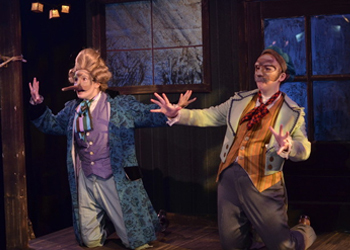
Truffaldino (Lydia Hiller) and Brighella (Kara O’Connor) express their fear of the forest.
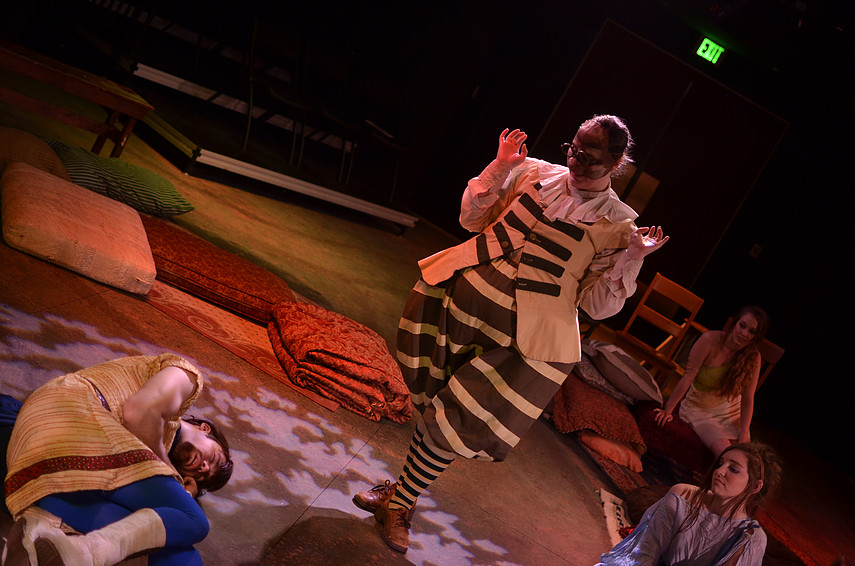
Tartaglia (Paige Conway) discovers Farruscad sleeping.
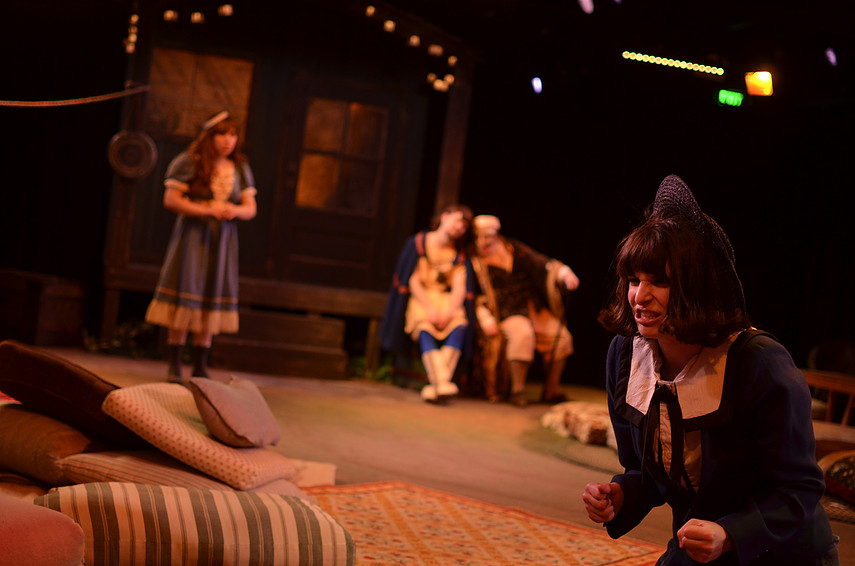
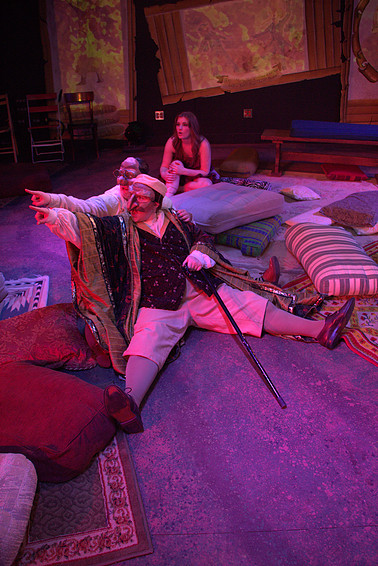 Left: Bedredino (Brittany Nicol) and Rezia (Tara Marier) explain their mother’s disappearance. Right: Pantalone (Carolyn Conover) and Tartaglia (Paige Conway) are unsure what direction to go.
A significant aspect of the adaptation was the creation of additional fairy characters based on the stage directions “Thunder, Lightning and Earthquake.” The Fairies served as a Greek chorus and controlled the puppets that represented the three tasks Farruscad must overcome in order to win Cherestani back (fighting a bull; fighting a giant; kissing a snake).
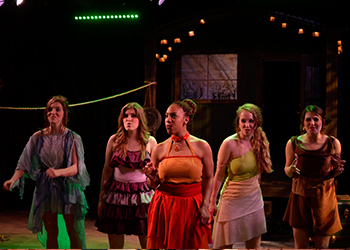
L to R: Christi Thibodeaux as Zemina; Katherine Schooler as Tuonara, Jalyn Greene as Farzana, Jenna Jo Pawlicki as Fulmina; Marley Boone as Terramota.
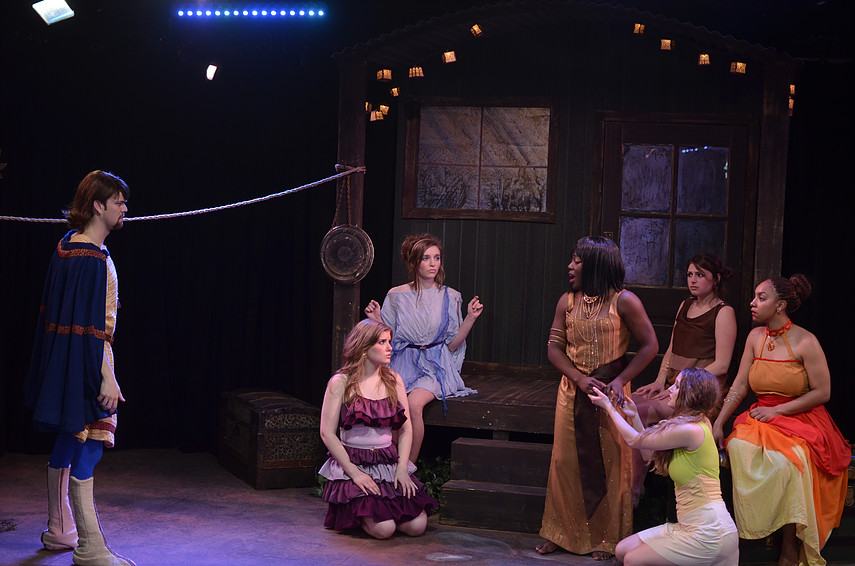
The Fairies surround Cherestani (Adia Alli) as she confronts Farruscad (Casey James Knight)
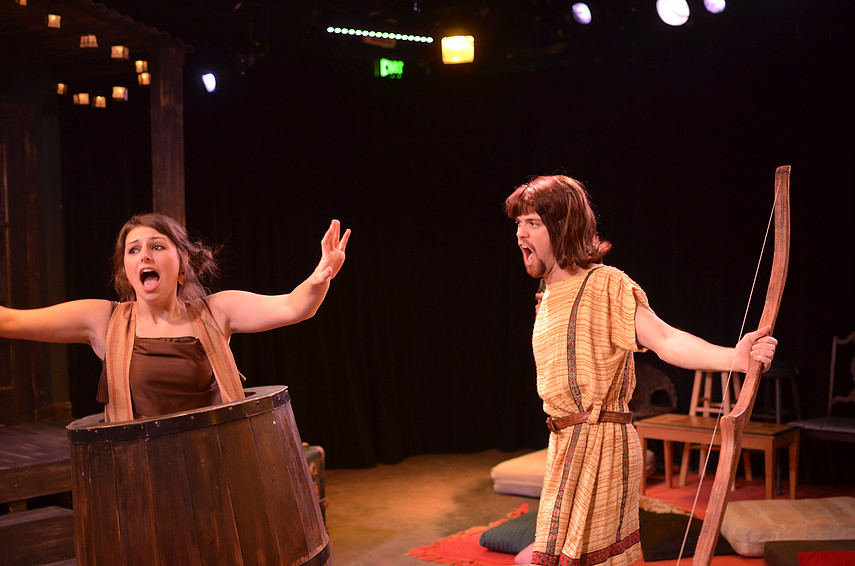
Farruscad fights a Bull.
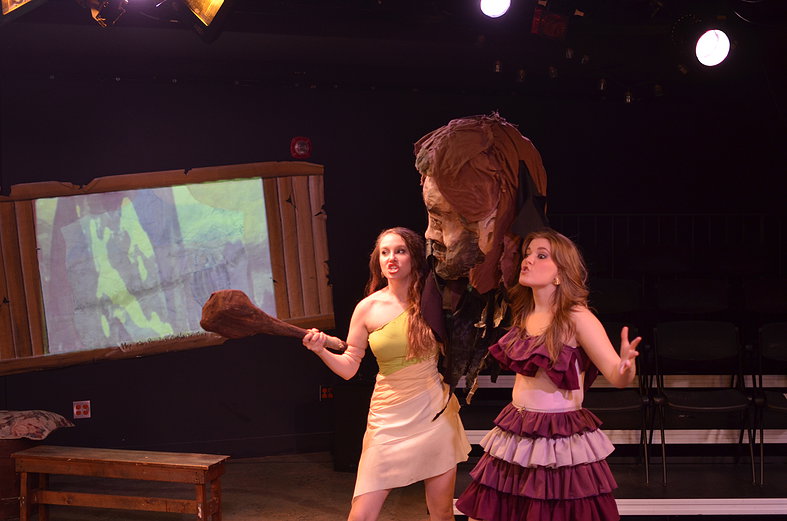
The Giant mocks Farruscad.
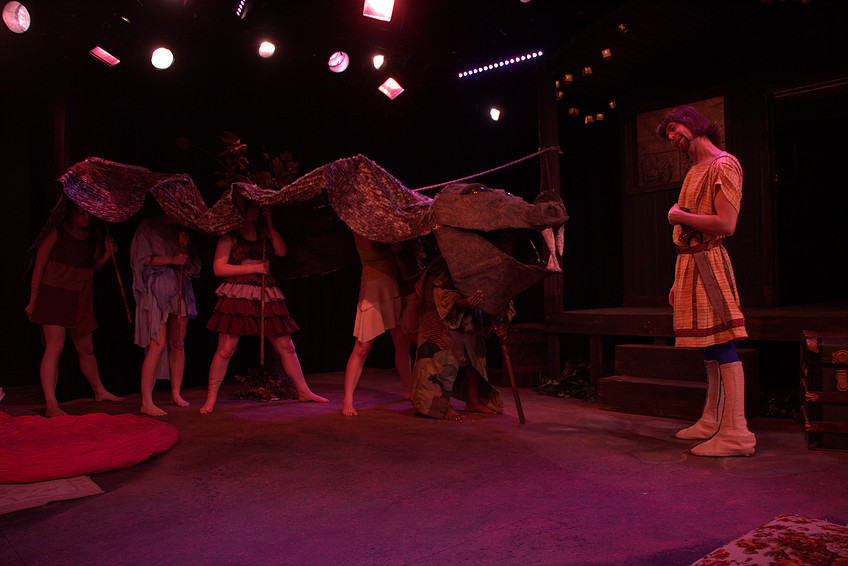
Farruscad faces the Serpent.
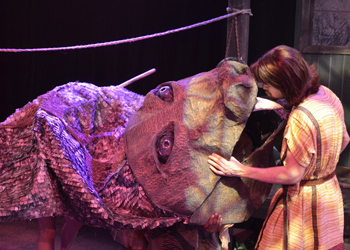
Farruscad kisses the Serpent, releasing Cherestani.
My Director’s Note from the program describes some of the main ideas of the production:
When I was asked to propose a “magical and fantastical” show for this season, I thought of the work of Carlo Gozzi. As a theatre historian, I knew Gozzi’s plays primarily because of his conflict with the playwright Carlo Goldoni. While Goldoni favored a more regularized, literary comedy, Gozzi wanted to continue the use of masks and improvisation, telling old stories in old ways. The Serpent Lady is a commedia dell’arte fairy tale; in many ways this is a play about the magic of theatre. In our production, the story is told by a group of fairies in collaboration with a troupe of actors whose origins in commedia have adapted and changed over time. Our ensemble draws on a variety of theatrical and literary traditions beyond commedia, including melodrama, Greek tragedy, blason poetry, epic, and myth.
At its core, The Serpent Lady is a story about how love can conquer not only death, but immortality. Farruscad and Cherestani must place their faith in each other, a lesson that proves more difficult for Farruscad than for Cherestani. Love is initially a force that weakens Farruscad, but he ultimately approaches love in a new way that leads him to greater maturity.Our production is also inevitably about gender, partly because Gozzi is often accused of misogyny. Casting an ensemble of sixteen women and one man represents an effort to challenge traditional gender roles and to practice resistant reading.
Working with a new translation has allowed us to mine the improvisational spirit of the play, and to bring contemporary humor to a piece that inhabits the world of fairy tales: “Once Upon a Time, in a faraway land…”